

A New Look for Patent & Trademark Magazine: The Shift to Horizontal Writing
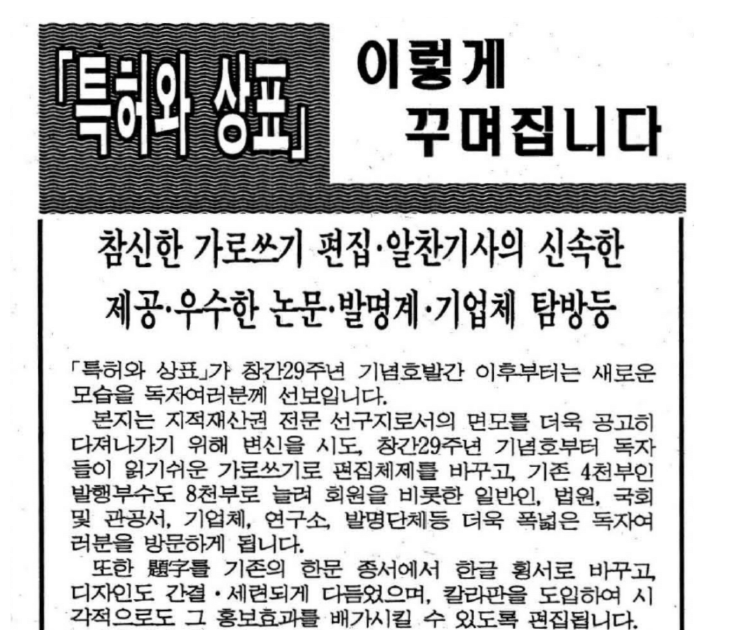
「특허와 상표」가 창간 29주년 기념호 발간 이후부터는 새로운 모습을 독자여러분께 선보입니다.
본지는 지적재산권 전문 선구지로서의 면모를 더욱 공고히 다져나가기 위해 변신을 시도, 창간 29주년 기념호부터 독자들이 읽기 쉬운 가로쓰기로 편집체제를 바꾸고, 기존 4천부인 발행부수도 8천부로 늘려 회원을 비롯한 일반인, 법원, 국회 및 관공서, 기업체, 연구소, 발명단체 등 더욱 폭넓은 독자여러분을 방문하게 됩니다.
또한 題字를 기존의 한문 종서에서 한글 횡서로 바꾸고, 디자인도 간결·세련되게 다듬었으며, 칼라판을 도입하여 시각적으로도 그 홍보효과를 배가시킬 수 있도록 편집됩니다.
The Patent & Trademark magazine is set to debut a refreshed format, beginning with the issue following our 29th anniversary edition.
This magazine, a pioneering publication dedicated to intellectual property rights, is introducing a major change with the adoption of the horizontal left-to-right writing system. Beginning with the issue following our 29th anniversary edition, this transition is intended to enhance readability and further modernize our presentation. As our circulation expands from 4,000 to 8,000 copies, we look forward to reaching a broader audience, including the general public, courts, the National Assembly, government agencies, companies, research institutes, and organizations dedicated to innovation.
In addition, the masthead (題字) will be changed from vertical Hanja text to horizontal Hangeul. The design will be refined into a more streamlined and sophisticated style, and the introduction of color printing will enhance the magazine's visual impact and promotional effectiveness.
Need a Korean patent document translated with this level of precision?
We handle office actions, patent publications, prosecution files, and more.
If you pick up an issue of 특허와 상표 from the early 1990s, the first thing you notice is how different it looks. The text runs top to bottom, right to left. Chinese characters (漢字) are mixed freely with Korean script. The whole thing reads like a document from a different era, and in a real sense, it is.
This excerpt from Issue No. 407, published July 20, 1996, is the magazine's editorial team announcing that all of that was about to change. They were switching to horizontal writing, dropping the vertical Hanja-heavy format, redesigning the layout, introducing color, and doubling their print run from 4,000 to 8,000 copies. What's interesting is how matter-of-factly they present it. No hand-wringing about tradition. Just: this is how we will present content moving forward.
The timing makes sense when you look at what was happening across Korean publishing in the 1990s. The transition from vertical to horizontal writing had been building for decades, starting after liberation in 1945, but most major institutions were slow to move. The regional 호남신문 in Gwangju was actually the first Korean newspaper to go horizontal, back on August 15, 1947 (김은신, 《이것이 한국 최초》, 삼문, 1995, pp. 96–98). Among major national dailies, 한겨레 was the first when it launched in 1988 with horizontal formatting from day one (한국학중앙연구원, 한국민족문화대백과사전). But the big conservative papers held out much longer. 중앙일보 didn't switch until October 1995. 동아일보 followed in January 1998. 조선일보 was the last, converting in March 1999 (한국언론진흥재단, 다독다독). Legal texts and the Official Gazette (관보) made similar transitions through the decade, though traces of the old vertical system still survive in Korean statutory language today. The expression "左의" (meaning "the following," literally "to the left") only makes sense if you remember that text used to run downward, and you looked to the left column for what came next.
I guess more than anything, what I find valuable about this excerpt is that it captures the transition from the inside. This isn't a historian looking back. It is an editorial team explaining to their readers, in real time, why the magazine they've been reading for 29 years is about to look completely different. That kind of primary source material is hard to find in English, and it's exactly the sort of thing we work with every day.
김은신, 이것이 한국 최초 (삼문, 1995), pp. 96–98.
한국학중앙연구원, "한겨레," 한국민족문화대백과사전 (encykorea.aks.ac.kr).
한국언론진흥재단, "신문, 언제부터 읽기 쉬워졌나? 신문의 변천사 살펴보니," 다독다독 (dadoc.or.kr), 2014.